Aja Beech

  • Home
  • Poems
  • Short Stories
  • Journalism and Commentary
  • About
  • Poem + Meditation
  • Order

  • Puerto Rican artist: first Latino honored by the Woodmere Art Museum

    This article first appeared July 3, 2017 at AL DIA NEWS

    At 18 years old, Diego Hiromi Rodríguez Carrión moved from Luquillo, Puerto Rico to study at the Pennsylvania Academy of Fine Art, PAFA. In the four years since arriving in Philadelphia he has won many prestigious awards including the William Emlen Cresson Memorial Travel Scholarship, the Rose and Nathan Rubinson Prize, and the Woodmere Art Museum Purchase Prize. Now, at 21, Rodríguez Carrión is not only the youngest recipient of the Woodmere Art Museum Purchase Prize, he is the first native of Puerto Rico to win the distinguished award, and his piece, titled Exodus, will now be part of the permanent collection of the museum, located on Germantown Avenue in Philadelphia.

    Each year the director of the Woodmere Museum, Assistant Curator Rachel McCay, and the collections committee, comprised of non-staff members, attend the Annual Student Exhibition at PAFA and select a work for the Woodmere Art Museum Purchase Prize. Since 2012, the Woodmere Museum has awarded the Purchase Prize to ten artists in an effort to continue the support of artists that have studied or lived in the Philadelphia area and to grow the permanent collection with diverse new artists. In past years they have selected multiple artists for the prize, this year Rodríguez Carrión was the sole recipient of the prize.

    Born in 1995, Rodríguez Carrión eventually studied painting techniques at the Atelier San Juan under the guidance of artists Luis Borrero and Amber Lia-Kloppel He learned what he calls “Old Master” techniques in drawing and painting. In 2013, Rodríguez Carrión left his homeland to study at PAFA. The notoriety of the school in the art world and his attraction to figurative painting influenced his decision to study in a new city with instructors who primarily taught in English. He achieved his Bachelor’s Degree in Fine Art studies at the school with a focus in painting. While his concentration was in oil painting, he also enjoys working with woodcuts. “I knew that PAFA is well-known because of this type art, that was one of the reasons why I decided to get enrolled in son I can improve my technique while I develop my vision of art,” Rodríguez Carrión said.

    Rodríguez Carrión is the first native of Puerto Rico to be awarded the Woodmere Art Museum Purchase Prize. On that honor, and the honor of having a piece as a permanent part of a museum collection at such a young age, he said “this award is a blessing and a pride, not only for me but for my family. I am excited because, at my age (21), the [Woodmere Art Museum] bought one of my works and included it in their collection.”

    “We are thrilled to include this work and for it to be awarded the purchase prize this year.” McCay said of Exodus. “We focus on Philadelphia’s artists and being able to represent one of the oldest institutions in Philadelphia, the Pennsylvania Academy of Fine Arts is important to us and to represent their growing student body.” The piece will be included in an upcoming exhibition, Cutting Edge: Recent Acquisitions in Woodcut, which will be on view from early September through October 2017. The Woodmere Museum considers the work by Rodríguez Carrión, and the other artists in the exhibition, to expand the understanding of working in wood as an artistic medium.

    “We have work by a lot of prominent printmakers and artists that work with wood as a medium,” McCay said, “this piece adds significantly to that aspect of our collection. The work is an impressive monumental tryptic that we are looking forward to including in exhibitions and being part of the collection, it’s incredible and the scale and the mastery of the medium is very clear and the entire committee was unanimous in awarding the prize to Diego.”

    Exodus is a triptych, meaning it consists of three art panels each depicting a specific theme on its own, while telling a larger story as an entire piece. The wood engraving stands at 6 feet tall and a total of 2 feet wide, each panel is 6 feet by 4 feet and, along with the wood, contains elements of coal, pencil and engraving ink. Art created in the style of a triptych have been popular in Christian art for hundreds of years as a way to relay religious themes and stories from the Bible, but can relay many themes and stories within its panels. For Rodriguez Carrión Exodus is about addressing political and financial issues causing immigration from the island of Puerto Rico to mainland United States, and the future of his homeland of the island itself, along with the strong cultural heritage, if it is abandoned by generations of inhabitants.

    “I decided to do this project in wood-engraving since it reminds me Puerto Rico. The theme of “Exodus” is about the economic situation that Puerto Rico is going through, in which the government declared itself in bankruptcy. It is about the emigration of many Puerto Rican families to the United States because of the lack of jobs and money there. The first panel illustrates two elderly people with gestures of sadness because their generation migrates to another country looking for a better future, while they are left alone. The elderly couple represents the current Puerto Rico. The second panel depicts how nature takes control of banana plantations (bananas are part of the Puerto Rican diet) by abandoning the land. If there are no people who cultivate the land all the fruit is lost and there is no food. The last panel is an empty bed in between two curtains. The light falls on the middle of the bed representing the line between life and death. With this panel I want to say that if the future, which is the youth and this generation, is leaving Puerto Rico, the country dies with no future.”

    While Rodríguez Carrión plans on visiting areas of Spain, including Madrid, Toledo, Seville, and Barcelona with his Cresson Scholarship to expand his artistic outlook and practice, he believes Philadelphia is an important place to see and discover art, both in the city and within yourself as an artist.

    For him, all of his work is about his identification with his heritage, culture, family and devotion to his religious beliefs. Exodus exemplifies all of these things for Rodriguez Carrión. “I am a family guy, my family is a big part of me and the person that I am. It is important for me to fully represent them and Puerto Rico. I want my family and my country to be proud of me.” He said.

    More about the art of Diego Hiromi Rodríguez Carrión can be found at www.diegohiromi.com/(link is external)

    Cutting Edge: Recent Acquisitions in Woodcut will be on view at the Woodmere Art Museum, 9201 Germantown Ave. September 2 through October 29, 2017.
     

    Share this:

    • Click to share on X (Opens in new window) X
    • Click to share on Facebook (Opens in new window) Facebook
    • Click to share on LinkedIn (Opens in new window) LinkedIn
    • Click to share on Telegram (Opens in new window) Telegram
    Like Loading…
    July 25, 2017
    Latino artist, PAFA, Pennsylvania Academy of Fine Art, Philadelphia, woodmere art museum

  • A Common Thread

    This article appeared September 29, 2016 at THE HUFFINGTON POST ARTS

    2015-09-28-1443448657-4265876-BonnieMacAllisterart1-thumb.jpg

    “When I first moved to Philly I had a lot of time on my hands.” MacAllister told me on a summer evening. After finishing with her day job, we met at the office she has at Culture Works, where she conducts business related to her artistic work. If she is not at her day job, or making her art, MacAllister is taking a class or being an active participant in art communities. Putting in all this time for her work is more than typical, “it is a basic need” for her.

    “I started going to these social events with poets, but I needed something to do with my hands, so I would even be there sitting knitting at these events, I really liked to sew, my grandmother taught me, I was born on her 60h birthday. I like to be able to spin my own yarn and create materials and I guess that comes from this love I have for things that remind me of my grandmother.”

    While her grandmother did not teach MacAllister to spin yarn into thread, they would talk about fiber arts and read books on knitting and sewing together. The wheel she spins fiber into thread on to is the only one of its kind in America, MacAllister tells me. The others are exclusively used in Tanzania. The spinning itself, she learned when she went to Ethiopia six years ago on a Fulbright-Hays award.

    “I think a lot about Ethiopia, it’s almost Ethiopian New Year, and I’m still drawing the women I met there, still drawing friends of mine that are there and turning them into embroideries. I went over and got to spend a lot of time with the fiber communities there, and that’s where I learned to hand spin, in Ethiopia. Every time I spin (thread), I think of Ethiopia.”

    Many aspects of the fiber communities in Ethiopia she visited appealed to her, but one thing stood out to her. The community itself and the ability for fiber arts, whether spinning, weaving, sewing or knitting, that across cultures these activities were social activities that created bonds.

    “The families work together on weaving, it’s cooperative, but I think a lot of fiber work is like that, being able to learn fiber, show other people, and keep the tradition going. For me, I know I have things I didn’t learn from my grandmother, but because now I’m part of the Philadelphia Guild of Handweavers, I’m learning from all of those people over there. Master felting classes, spinning classes. I feel like I found what I really wanted to do with my art.”

    “It’s kind of a labor of love, but it takes me a long time, I’m at the machine at least three hours during the base of a piece, after that I hand sew for hours and hours and hours.”

    MacAllister also concerns herself with where all of her materials come from. That the materials are sustainable, eco-friendly and accessible to all is of the utmost importance. “I go to every fiber festival I can,” she explains of how she obtains her materials, “I go to farms, sheep and wool festivals, and I make sure I get materials from places where I know my money goes directly to that farm and that family and their animals. I get silk from Darn Good Yarn, a nonprofit that helps women in India and Nepal earn a living wage. There is a place out past Lancaster called the Manning’s, where you can just go to this enormous barn, and just get materials directly from those folks. And I seek out materials when I travel, l was in Taos and I made sure I went to a weaving collective, a store in downtown Taos where I spent a lot of time talking to the people who ran in. I thought it was hilarious, they told me, ‘Oh, Julia Roberts got some of this last week.’”

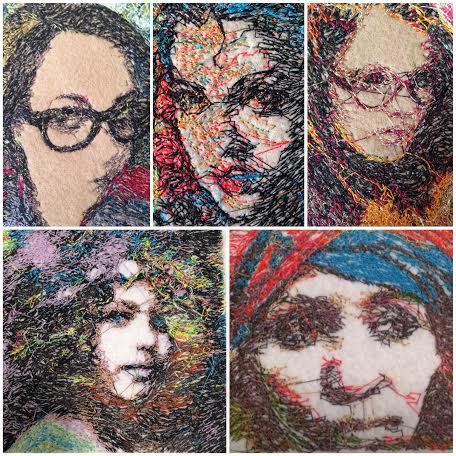
    Prior to the embroidery, MacAllister was focusing on painting and poetry as her artistic mediums. In 2014, MacAllister was involved in The Ragdoll Project, a community based art project that create awareness about human trafficking. Through Philadelphia Women’s Caucus for Art, women made ragdolls from hand; the dolls have since traveled to galleries and events internationally. All proceeds from project continue to go directly to women in America and abroad that are survivors of human trafficking and sexual exploitation.

    “After we sold those ragdolls I couldn’t stop sewing, and I really started these embroideries after that. It was really getting in touch with everything that bothered me, everything that bothered me about human trafficking, and the things that are wrong in the world; I really wanted to sew the people that were heroes.”

    For MacAllister fiber art is very fulfilling because of how physically interactive it is as an art form. It is also about more than the feeling of making something by hand. “For me,” MacAllister said, “fiber has always been about being with people.”

    In Philadelphia, there are a few artist communities that MacAllister is involved in that help nurture her growth as an artist. At NextFab, a manufacturing co-operative located in South Philadelphia, she uses machinery to create the embroideries.

    Of the process, MacAllister told me she starts by creating a drawing or sketch of a photograph, which she is then able to scan into the machine. “I work collaboratively with the machine.” She said, “You hand feed every single thread, it’s more like painting and using the arm of the machine to help guide it. I get to do a lot of really straight lines and forms, just like an outline, almost like a line drawing in thread, and then on top of that I build little layers of hand sewn embroideries.” Each portrait, even working collaboratively with the machine, can take days to create.

    “It’s kind of a labor of love, but it takes me a long time, I’m at the machine at least three hours during the base of a piece, after that I hand sew for hours and hours and hours.”

    As for incorporating social issues into her art, it seems to come naturally to MacAllister. “I’m one of those people who always really cared about communities, even as a young teenager.” She finds it not only therapeutic for herself, but for everyone involved. “I found community groups to get involved with, through art making I found it was very comforting to a lot of people who are survivors of different violence, to come together and sew together, to come together and paint a mural, to come together and knit bomb a neighborhood. That can be extremely constructive for people to channel things into art, for me I always channeled all of my things into art.”

    Bonnie MacAllister
    CultureWorks Greater Philadelphia
    Saturday and Sunday, October 3 & 4
    12-6
    FREE Fiber demos: including spinning, weaving, felting, ice dyeing, creating community sculptures know as knit bombs


    Share this:

    • Click to share on X (Opens in new window) X
    • Click to share on Facebook (Opens in new window) Facebook
    • Click to share on LinkedIn (Opens in new window) LinkedIn
    • Click to share on Telegram (Opens in new window) Telegram
    Like Loading…
    July 24, 2017

  • Bail an injustice for Philadelphia’s poor

    This essay first appeared AUGUST 11, 2015 on ESSAYWORKS at WHYY NEWSWORKS


    It is estimated that up to 65 percent of those in prison in Philadelphia are awaiting trial and have not been convicted of any crime. Many of them simply cannot afford to pay their bail.

    “There is supposed to be some common sense in the law,” says Tim Devlin, an ex-convict who has seen Philadelphia’s unfair bail system from the inside, “and I think a lot of that has been forgotten.”

    Fortunately, it has not been forgotten by everyone. A bill to “eliminate pre-trial detention for failure to post bail” is being drafted right now in the office of State Sen. Daylin Leach, a Democrat who represents parts of Montgomery and Delaware Counties.

    “People who struggle to make ends meet often face challenges that may not be obvious to the rest of us,” Steve Hoenstine, director of communications for Leach, says of the motivation for the bill. “If you aren’t poor or haven’t been through the criminal justice system, you probably wouldn’t be aware of the grave injustice that our current bail system imposes on the poor.”


    What sticks with people

    Devlin has a lot to look forward to these days. The father of three will be getting married soon. His third-shift job, working overnight, can take its toll, but he always makes time for his family and his music. He did not always have this outlook, though. When he was between the ages of 18 and 22, he amassed quite a rap sheet for possession, of drugs and weapons, vandalism, criminal mischief, and more.

    “I’m 36 years old,” Devlin says. “I haven’t been convicted of a crime since 2002. That’s a long time. My fiancée even tells me, ‘A lot of time, when you do things, I can tell you’re really apprehensive about it because you’re scared of stepping out of the line.’ If I step over the line a little bit, it’s like: He’s been convicted. We got him. It sticks with you for a long time.”

    What sticks with people is the entire jail experience, from beginning to end. Not everyone is privy to the ins and outs of the justice system, until they are within the justice system, and at that point there is very little you can do. Devlin says what he saw was that “a lot of the time you’re just trying to exercise your rights, and they try to use that against you.”

    The case of Sandra Bland in Texas, and the trouble she faced trying to make $500 bail, has brought some of the issues about prohibitive bail to light recently across America. When it comes to prison issues, Philadelphia is too close to the top of a very undistinguished list. We have one of the highest prison populations in the nation.

    One of the first encounters with the court system after arrest is a bail hearing.

    “You have people who are unemployed or minimum wage, and they give them $30,000 bail for possession of marijuana,” Devlin says of his experience. That number, though, is not far off. The typical bail request in Philadelphia is $20,000. As for making that bail, Devlin continues that “in Philadelphia you have to pay 10 percent. So that would be $3,000 that they have to pay, but still, you know what I mean. You take someone that is unemployed or maybe has one or two other arrests for possession of drugs or something, and they give them something they can’t possibly make.”

    If a person cannot make bail, there is only one choice: to remain in jail.

    In Devlin’s experience, “You have 24 hours after you see the bail commissioner to pay bail. If you don’t make it, you go up State Road, once you get to county up there. Then you sit on State Road. If you can’t make bail, you just sit there until your court date. But the problem is … I’ve seen people on State Road for a year for a nick bag of weed.”


    ‘Speedy justice’ lags on

    Statistics show that 15 percent of pretrial inmates are in jail for 120 days or longer awaiting trial. Philadelphia pretrial holdings for bail have increased 40 percent since the time Devlin was last in prison, and even then he says he noticed the issues with high bail, and who they seemed most applied to — not just at bail hearings, but while in prison.

    “I’ve been in the prison system in California, in Jersey — it’s always pretty much the same any way you go,” Devlin says. “But in Philly, you got guards who don’t even want to be there, and just for no reason, won’t let people out on the block, so they can’t call their family or something. Like, you could have court the next day and they just don’t feel like letting people out, they just won’t. You can’t call your family, you can’t prepare for things, the law library that they just won’t let you to. You can’t even get access.”

    Month after month, hearing after hearing, the entire process, which purports speedy justice, lags on, breaking people down — keeping them from their loved ones, causing them to lose legitimate jobs, on charges that are sometimes dropped altogether, simply because they cannot pay a fee.

    “I think that there is a racial aspect to Philly as well.” He tells me, “I can remember being in the district, with people with the same charges who are black, and I would get ROR [released on own recognizance], and they would go up and get the $3,000. You know what I mean? It’s like, damn, it’s kinda crazy.”

    In Philadelphia, about 40 percent of arrests get ROR, while 60 percent get bail. And 66 percent of the entire inmate population is African-American.

    Once a person is able to make bail, and appears in court, they do not get the entire bail returned to them. Only 70 percent of a bail posted is returned to the person who posted it in Philadelphia. That means that on a $3,000 bail, even if the person arrested is found innocent, it will end up costing them $900.

    “You have the privatization of prisons now,” Devlin says, “and it just seems like the punishments are harsher, especially financially.”


    Taxpayers’ savings

    Hoenstine says that Leach’s bill intends only to “eliminate pre-trial imprisonment unless a judge finds the defendant is a danger to themselves or the community, has a history of flight, or is charged with a capital crime. Defendants who do not fit that criteria would be released and expected to appear in court. If they fail to appear in court, they’d be subject to a monetary penalty set by the judge.”

    With all of the costs associated with being in the prison system for inmates, it is still estimated that of every tax dollar paid in Philadelphia, seven cents goes to the prison system, where over half of those interred are awaiting trial. The financial advantages of eliminating specific bail circumstances are still being considered, and Hoenstine says Leach is trying to reach across lines to find support for this bill and is even “eager to work with members of the Republican Party — particularly fiscal conservatives who know how much money this could save taxpayers — to produce language that can pass.”

    “They say they’re basing [bail] off your record. They’re supposed to take your income as a factor,” Devlin told me. “Sometimes with the crimes, it seems like they’re targeting low-income people.” With a change to bail, Philadelphia can stop confining its poorest residents and look to join some more prestigious lists, lists of cities lowering their prison population.

    Share this:

    • Click to share on X (Opens in new window) X
    • Click to share on Facebook (Opens in new window) Facebook
    • Click to share on LinkedIn (Opens in new window) LinkedIn
    • Click to share on Telegram (Opens in new window) Telegram
    Like Loading…
    July 24, 2017
    Bail, Bail reform, Cash Bail, Criminal Justice, Justice Reform, Philadelphia

  • Murray Bailey upbeat, even in defeat

    This article first appeared November 4, 2016 at AL DIA NEWS 

    Republican candidate for mayor, Melissa Murray Bailey, was busy election night. She spent part of the evening at Fitzpatrick Recreation Center in the far Northeast, where she once worked the polls during an election for current Representative Martina White. Murray Bailey called the feeling of the polling place “special and supportive.”

    Murray Bailey and her party faced an uphill battle in the Philadelphia elections, where Democrats are estimated to outnumber Republicans 7 to 1.

    At the United Republican Club later in the evening, Republican Party members wearing yellow “I’m with Melissa” shirts anxiously awaited her arrival after the polls closed. She arrived around 9 p.m., after the AP called the race for her opponent, Democratic candidate Jim Kenney.

    The room at the United Republican Club was also filled with Murray Bailey’s family members, including her husband, behind her on stage with a yellow volunteer shirt, and her sisters and parents in the audience. Her daughter traveled with her through election night.

    “So many people from across the city really did come together,” Murray Bailey said, “on a common message to build a better Philadelphia. What we did here is incredible. We talked about real issues holding the city back, the fact that we’re not friendly to business, the fact that our public schools are failing so many of our children, and we created a real platform for change.”
    The feeling at the United Republican Club after the race was called for Kenney was not so much one of defeat, as of relief. The talk of the evening, before Murray Bailey arrived, was of the turnout for their Party in this election. They were looking for revitalization, and still felt as though they had found it in Murray Bailey.

    “From a standing start last winter, we put a new face on the Republican Party in Philadelphia, a face that we can all be proud of.” Murray Bailey said. “We have touched so many parts of this city, especially those that have been the most neglected.”

    She also told a story of a POW bracelet she has worn since it was given to her by First Lieutenant Ralph Galati after they met this past Memorial Day. “Any time is gets hard and I felt like, this isn’t fair, what are we doing here? I just looked at this bracelet and I remember that so many other people have things so much harder than what we went through here. And if this campaign was able to bring some light and life to people who needed it most, than that’s what this campaign was all about.”

    Share this:

    • Click to share on X (Opens in new window) X
    • Click to share on Facebook (Opens in new window) Facebook
    • Click to share on LinkedIn (Opens in new window) LinkedIn
    • Click to share on Telegram (Opens in new window) Telegram
    Like Loading…
    July 24, 2017
    Mayor’s Race, Melissa Murray Bailey, Philadelphia

  • DesignPhiladelphia looks to ‘Shift’ everything

    This article first appeared October 5, 2015 at AL DIA NEWS

    Now in its 11th year, DesignPhiladelphia(link is external), a week long long celebration of the growing design community in the city, will get under way October 8.

    Antonio Fiol Silva, has brought a considerable amount of attention to Philadelphia recently, as an up and coming center of urban development. The San Juan, Puerto Rico native is the first architect in 20 years, and the first Latino ever, to be appointed district council chair for the Urban Land Institute, a national urban development non-profit organization that will be having its spring meeting in Philadelphia in 2016. He is also busy planning for the 2016 American Institute of Architects national conference. First up though, is DesignPhiladelphia. Fiol Silva is the Center for Architecture(link is external) Board President and so oversees this year’s event and its theme, Shift.

    “What is happening in Philly is not just about the big Comcast tower that is going up or the big hospital,” he said, “it is also what is happening in the all of the neighborhoods, and the maker spaces, and the communities, so that it really is happening throughout the city, it is not one sector that is doing well, it really is a bit of a renaissance and a spring, so the concept of ‘Shift’ really comes down to capturing that and calling attention to that.”

    Shift is DesignPhiladelphia’s 2nd year under the auspices of the Center for Architecture. “There really is a shift going on in the city and it’s not just about new buildings.” Fiol Silva says of the motivation for this years’ theme. “One of my favorite  silly cartoons is this little chicken comes out of the egg and says ‘Paradigm shift!’ it is something very different and I think on some level, in the city, we have come out of our shell.”

    Philadelphia as a center of urban development

    While the burgeoning skyline is part of the development of Philadelphia as a hub for urban design, it is not limited to high rise buildings and center city. “Neighborhoods that before were thought of as not being good places to live are now very desirable,” Fiol Silva says. Primarily desirable to the current neighborhood residents.

    “Urban design, urban planning is all about taking the broader view of things,” he added. “So, it’s not just about that one building but how that building fits in in a city, fits in a society, fits in time and place. When you take the broader thing, sustainability becomes very important because you look at the things that are enduring and the things that really make sense.”

    “Now a days the other word that people are using for sustainability is resiliency, the ability to endure.”

    This idea of design resiliency, he tells me, started coming up in the aftermath of natural disasters. It is a design theory concerned with community. “There are many dimensions to what sustainability means. People can be healthier; it can be more economically sound.” He said it is design “that is building community but is also building economy.” The designers this year want to portray that anyone, anywhere can shift their environment into on that is more beneficial to them.

    “One of the events that we have is the Pearl Street Passage.” Fiol Silva says the Chinatown area event as an example of where an alleyway will be transformed into an open green space. “Participants will not only be able to experience the area, they can learn how to take any alleyway and transform it into becoming a vital open space.”

    The Center for Architecture has a permanent space on Arch street that is “a hub for activities that happen not only during design Philadelphia, but stretch year round,” Fiol Silva tells me, much like the Fringe Festival and the permanent building on the corner of Delaware Avenue and Race Streets they now have, which he just so happened to design.

    The Arch street CFA building has a gallery and interactive exhibits for children, and is one of the many destinations, along with the Pearl Street Passage, located in the Chinatown section of the city for DesignPhiladelphia. Another design destination in Chinatown is near 13th and Spring Garden streets.

    Paradigm shift!

    The origins of MIO Culture, or MIO, can be traced to Philadelphia. Designer Jaime Salm, originally from Medellin, Colombia, who attended the University of The Arts in the city to study industrial design.

    “Originally I was into sculpture.” Salm says, “On the weekends I would get my car and take the passenger seat out and go to junk yards, buy junk, and then I would weld up sculptures out of junk.” While he found sculpture fulfilling, despite the constant reconfiguration of his automobile, as far as considering sculpture a career, Salm was not convinced that was for him.

    One day, as a teenager in the late 1990s, he said someone mentioned industrial design to him and suggested it as a career. “I asked what (industrial design) was and they told me it was product design and designing for industry, so I thought it was interesting, I’d give it a whirl.’ I realized as I was doing these courses that I did like design, that design was for me, it was artistic but it also had all these constrictions about society and how we live. I like the idea of a creative process that has constrictions, not just go out and tell us how you feel, go out and tell us what you think, this is all nice, but how about go out there and figure out how to solve these problems.”

    His parents still lived in Medellin at the time, and it turned out of all his options, Philadelphia offered him the ability travel more freely back and forth as he studied in America. The fundamentals of his sustainable design principles he attributes directly to his time as an undergraduate.

    “The University of the Arts had an emphasis on sustainability at the time, it still does to this day, I think. For me, I came to realize that good design is not just is not just good design, good design is sustainable design, so you cannot separate the idea of sustainability from the design.”

    “You mean that that is a great building but someone who has a disability can’t get into the building, how is that a great building? I don’t care how pretty it is, I don’t care how much it cost, it has to be designed for society, it has to be designed for humans and our needs, and accounting for what is coming along in the future, not just the present.”

    Active sustainability

    Salm developed a design philosophy years ago — active sustainability. “It is this concept that there are some products out there that are not made domestically, that may use harmful chemicals, and then you start looking at the entire life-cycle of something and you ask, what is the true impact of that? You begin to look at products, materials, processes, manufacturers in a more systematic kind of way, not just the short-term thinking of ‘that must be great because it is recyclable,’ maybe it is not great. You really have to really stand back and look at the full package.

    For example, buying an individual bottled water is not very sustainable, recycling it helps, but there are water bottles you can reuse, those bottles would be a kind of cursory, or illusory kind of sustainable because it can still has some kind of negative environmental impact if it will not last very long, if it is made using unethical labor practices, or it is manufactured with chemicals that harm the environment. A reusable water bottle that is made without harmful chemicals, that can last many years, and that can still be recycled at the end of its own life cycle would be active sustainability.

    “With this idea of active sustainability, what I’m concerned about is: ‘how can we make products that provide additional environmental benefits every time they are used?’” Products need to be more than environmentally sound, they must be environmentally beneficial. The design must do more than take minimally from the environment, it should give back.

    MIO has evolved as a company since incorporating this philosophy. In the beginning Salm says he was very material and process driven, creating beautiful and at least what he now considers partially sustainable products. All of the products now constructed by MIO are done so with a systemic approach considering all the variables of active sustainability.

    During Design Philadelphia, Friday October 9 from 6 to 9 p.m., MIO will open their studio at 511 North 5th Street, to the public — a building they rehabbed and have been in for a year now, showing just how committed the company is to their design philosophy. “It was an empty warehouse for about 30 years, we came in here and gutted it and cleaned it. Before that we were two blocks away at an old fortune cookie factory.”

    Share this:

    • Click to share on X (Opens in new window) X
    • Click to share on Facebook (Opens in new window) Facebook
    • Click to share on LinkedIn (Opens in new window) LinkedIn
    • Click to share on Telegram (Opens in new window) Telegram
    Like Loading…
    July 24, 2017
    Antonio Fiol Silva, center for architecture, Design Philadelphia, Mio Culture, Philadelphia

  • OuterSpace: From the streets of Philadelphia, a lifelong brotherhood

    This article first appeared March 30, 2015 at AL DIA NEWS   

    On a cold March Sunday evening, Mario Collazo and Marcus Albaladejo were in Scott (link is external)Stallone(link is external)’s studio in South Philadelphia recording their latest work, the long anticipated Lost in Space album. More than a few trials and tribulations have kept this album at bay, including Albaladejo’s stage 3 cancer diagnosis in 2013. He has triumphed over the disease for now and is healthy. When he spoke about it, Albaladejo brushed it off, as nearly inconsequential. A bump in the road among many they have overcome. An attitude of perseverance both he and Collazo believe comes from their shared culture.
    “Being Puerto Rican,” Albaladejo said, “even, the household you’re brought up in, there’s always something to remind you of where you’re family’s from. I was born and raised in Philadelphia, but my family wasn’t. My father is from the island; my mother is from the island and they would always remind us: Look these are your roots, always be proud of who you are and where you come from.”
    For Collazo, being Latino rappers “Makes us go harder. There aren’t many of us, you always feel like the underdog, it makes you try different stuff, or go harder, or be a little bit more arrogant. We have the same thing. It’s a cultural thing and it’s an American Philly thing.”
    That night, in the studio, they were in a competitive mood. Around 8pm, I walked into Stallone’s studio, a place Philadelphia rappers like Beanie Segal have walked into, and saw Albaladejo and Collazo sitting next to each other listening to the music on a new track, both of them writing. They hardly looked up from their pages. We pushed the interview back a few hours, so that they could get right to laying down the words they furiously wrote with such inspiration.
    Albaladejo and Collazo met years ago, when they were young teenagers in Philadelphia. They formed OuterSpace(link is external) in the early 1990s as a trio, with their mutual friend Richard Cruz, but it was the duo that would remain. Later that decade, they were recording with DJ Jazzy Jeff’s production company and they met up with the group Jedi Mind Tricks, lending their vocals to many tracks on the Illegaliens EP in 1999. The Jedi Mind Tricks collaborations eventually morphed into the Army of The Pharaohs, a hip hop super group developed by Jedi Mind Tricks MC Vinnie Paz. The group has seen a rotation of artists, some that were briefly members like one of Philadelphia’s favorite female MCs, Bahamadia, and long lasting members, like OuterSpace, Reef the Lost Cauze and David Albaladejo, also known as King Syze, Marcus’ younger brother.

    Listen to Outerspace's Delirium (featuring Rich Medina)(link is external)

    OuterSpace are more than brothers in music, they are brothers in law. Collazo is married to his high school sweetheart, Melissa Albaladejo, Marcus’ sister. The Collazos now have four children. Both members of OuterSpace love their music, but their first love, and their first priority, are always family. As Collazo explained it, their inspiration and motivation come from family.
    “That whole concept helps us make music.” Collazo said. “When your life isn’t organized, your regular life isn’t organized, it kind of makes the motivation die down. We both accepted in our lives that we really don’t care to be famous. When we were first touring and we first started seeing all that (fame could offer), we thought ‘Oh, this could actually go here, if we really really want it.’ But we started having kids and thought, we didn’t want it. And I think it made us go back to, like he (Marcus) said, to doing it for the love of the music, and we kind of always compete, in a friendly competition. The real life shit converts to the music, I think it makes it better for us now, because we’re more comfortable, we work, we have good jobs, we can afford to do this. We just put our lives first.”
    The group is never ashamed of putting their real lives out there. Whether it is the pride they have in their families, their work outside of hip hop, or their personal struggles, it is all out there. For Albaladejo, it is important to his self expression to be true to himself, but he is also thinking of the listener. “Somewhere down the line, there is a fan going through the same thing.” Even if some of the fans question Albaladejo and Collazo’s choices. One such fan once asked Collazo why he even had a job outside of hip hop. “I shouldn’t work?” was his response. “I got four kids at home, what you mean I can’t work. Working a full time job and wanting to do this is wanting to do this. We do it because it’s in us.”

    “We have careers to support our family and to be here.” Albaladejo added. “No matter what, you can’t live off music, you’ve got to have a backup plan.”
    Sometimes, there are situations, where the music can help, and OuterSpace has seen this in the past few years. They may have performed for thousands of people on European Tours with Jedi Mind Tricks and Army of The Pharaohs in 2011 and 2012, but for them, there is nothing like coming home and doing a benefit show for something important to their family. The benefit show they are getting ready for this year is an Autism Awareness Benefit(link is external) for the Variety Club April 25. Albaladejo’s oldest child, his son Nicko, was diagnosed with Autism at an early age.

    He and his son’s mother have been actively involved in every aspect of their son’s life and education, experiencing firsthand the support needed to help children on the Autism spectrum grow and thrive. Somehow, like the nearly nonchalant attitude about fighting stage three cancer, Albaladejo brings that same attitude to his son’s Autism diagnosis, he recognizes it is a struggle, one that he faces head on with no illusions while also turning it into a triumph, instead of letting it be a tragedy. For Collazo, their real lives have them “making better music, for the fun of it. Now we just do it to do it. We made a mark, that’s all that matters.”


    Share this:

    • Click to share on X (Opens in new window) X
    • Click to share on Facebook (Opens in new window) Facebook
    • Click to share on LinkedIn (Opens in new window) LinkedIn
    • Click to share on Telegram (Opens in new window) Telegram
    Like Loading…
    July 24, 2017
    HipHop, OuterSpace, Philadelphia, Philly Hip Hop, Rap Music

  • Philadelphia School District failing to protect the rights of students with autism

    This essay first appeared August 1, 2013 on ESSAYWORKS at WHYY NEWSWORKS

    Nearly 90 percent of all disabled children in any major metropolitan area require public schooling. The number of children being labeled as ‘disabled’ is increasing, but the Philadelphia School District has flat lined funding to the Special Education programs, despite not meeting annual yearly progress last year.

    Why is the Philadelphia local education authority failing to fulfill their obligation to those with special education needs?

    The Individuals with Disabilities Education Act ensures a “free and appropriate public education” and improvements in “educational results for children with disabilities.” I know this, in part, because I have a son who has autism.

    Few options for students with autism

    Like so many other children with autism in Philadelphia, my son attends public school. The reality is there are not many other options for him. Law requires any schools receiving government funding to accept children with disabilities, but not all schools are equipped to deal with them. In February of this year, it was widely reported that Philadelphia charter schools create significant barriers to enrollment.

    Pennsylvania Governor Tom Corbett thought offering the Opportunity Scholarship Tax Credit would be a viable alternative, so that children could “leave ineffective schools,” but in order to qualify for the credit the area public school your child would attend must be on an annual list of 15 percent of the lowest performing schools in all of Pennsylvania.

    “We just want the resources to do our job,” said Extended School Year Coordinator Jim Polisi on July 24, amidst the notification that there were to be hundreds of layoffs, including vital staff.

    Unstable school district holds many lives in the balance

    Some of those positions have since been restored, but even that day, the damaging effects of this funding rollercoaster were clearly taking its toll on everyone. There was a sense of a lack of stability as a distant entity known as the SRC seemed to arbitrarily decide the fates of so many people.

    “It’s the teachers that make the schools feel like home, and the students are awesome,” explained Bernadette Dye, a life skills itinerant teacher. Dye split her time between two high schools last year, including Kensington Business and University City.

    University City High School is one of the schools that will not be opening its doors in September.

    “The morale and physical structures are depleted by the school closings and the drop in attendance,” Dye said.

    The school district faces other depletions. Enrollment in all Philadelphia schools has dropped by nearly 4,000 students, while the population labeled as “disabled” remains at around 13 percent. Dye says special education teachers get very different kinds of students.

    A growing need

    The students in her classes, which consisted mostly of teenagers with autism, regularly attended and participated, because for those students school not only fulfills their need for education but their need for socialization in a comfortable environment. People like Polisi and Dye do their best to create that environment for their students with whatever funding they receive, but with close to one in every 50 boys being diagnosed with autism every year, a number that has doubled in the past two years, the rate of children requiring a special-needs education is only growing.

    Tanya Regli, executive director of the Arc of Philadelphia, which works with Include Me From The Start and the School District to provide additional support to students with disabilities, echoed the earlier concerns with cuts in staff and school closings.

    She noted that such dramatic changes are especially difficult for people with disabilities like autism because they are more sensitive to changes in their environment. Regli also mentioned that cuts have been seen “in the number of Philadelphia School District staff that provide direct services in the area of secondary transition,” or transition into life after high school.

    The recently, and temporarily, restored staff positions within Philadelphia schools should be the call to action for all of us. It has been indicated that Superintendent William Hite sited student protests as a major influence for continuing to find funding for the school district, but these children should not have to take to the streets to defend their right to an education.

    Will the public school students of Philadelphia need to take to the streets every few months to determine whether they will get a fraction of what would be considered adequate funding?

    Will the SRC and School District continue to lay off people and rehire them within weeks, only to tell them their job is still in danger?

    Which program will be cut, restored, or preserved this week?

    This back-and-forth is creating unnecessary difficulties for those that work in the school system and the families served by it. It is the job of the school district and the school reform commission to demand the money so that each child in Philadelphia can receive an adequate education, just as they managed to find $33 million the other day and hold off on some layoffs until January, none of which will be going to special education.

    Share this:

    • Click to share on X (Opens in new window) X
    • Click to share on Facebook (Opens in new window) Facebook
    • Click to share on LinkedIn (Opens in new window) LinkedIn
    • Click to share on Telegram (Opens in new window) Telegram
    Like Loading…
    July 23, 2017
    Americans with Disabilities Act, autism, disabilities, education rights, Philadelphia, Philadelphia School District

  • In quest to fund Philly DA’s office, don’t cut programs that work

    This essay first appeared May 23, 2013 on ESSAYWORKS at WHYY NEWSWORKS


    In November 2012, Isaiah Thompson wrote a piece for the Philadelphia City Paper, “How the Philly DA office spends millions of dollars is a mystery,” about the lack of transparency around money raised from the sale of forfeited assets linked to crimes. Six months later in April 2013 the district attorney himself, Seth Williams, was testifying in front of Philadelphia City Council, saying his office was one of the most underfunded in the country.

    How much is actually budgeted to the Philadelphia District Attorney’s office? And when so many programs in Philadelphia are experiencing budget cuts, like the school system, how many millions of dollars are enough to prosecute criminals and prevent crime?

    Budget crises are not unique to Philadelphia. In 2010, it was widely reported that the Bronx District Attorney’s office would need to lay off a large number of staff following reductions in their budget. The decision resulted in overworked prosecutors, some of the worst conviction rates, and exorbitant costs over time.

    In Michigan, the Wayne County District Attorney’s office, the only DA in the country that receives less funding than Philadelphia, has sued the county over lack of funding, and their prosecutors have now been instructed to simply not report to work for certain trials.

    Is this where Philadelphia is headed? Could we become like the Bronx and not follow through on nearly one-quarter of all prosecutions? Could our system fail to enforce accountability, as is happening in Wayne County (which encompasses Detroit), because the DA office cannot afford to have prosecutors in court?

    Hard numbers

    “We actually had more homicides in Philadelphia last year caused by handguns than all five boroughs of New York,” Williams reported at his City Council hearing in April.

    When I spoke with him on May 20, the day before the primary election, he said Mayor Nutter still had not communicated with him and that City Council’s support keeps him optimistic, but he knows the reality his office faces. Even with the extra $2.7 million he is requesting, his office will still be underfunded — and preventive programs and alternative sentencing programs will be sacrificed, not prosecutions.

    One of Williams’ major personal and professional endeavors is to prevent future crime. Take, for instance, his Second Chance Foundation, which funds programs that keep juvenile offenders from returning to the prison system, and his truancy diversion programs that mean to reduce the future prison population.

    “High school drop-outs are the majority of people in state prisons,” Williams noted.

    The Philadelphia District Attorney’s office has been allocated just over $31 million for the coming fiscal year. As a comparison, the Los Angeles County District Attorney’s office works with about $300 million dollars more. That amounts to an estimated $1,700 budgeted to prosecutors in Philadelphia for each incidence of violent crime. Los Angeles is estimated to spend $6,430 — more than three times as much. In Wayne County, Mich., it’s $1,344.

    How does this transfer to actual cases? As one example, according to Melissa Boyers Bluestein, legal director of the Pennsylvania Innocence Project, “Private DNA testing costs about $1,200 for a single test of an unknown sample and $750 for the test of a known sample.”

    In 2011, the Philadelphia District Attorney’s office reported using DNA testing in about 40 percent of cases. While they ahve not said how much they spend on testing, just a fraction of the private rate would cut deeply into each prosecution.

    Williams stated in his City Council testimony that his office is working with technology from the 1990s, and that while Mayor Nutter has proposed to increase funding for the Office of Innovation and Technology by almost 150 percent, none of that money will go toward modernizing technologies related to prosecuting crimes.

    Budget solutions?

    Danny Alvarez, Republican candidate for Philadelphia District Attorney, says on his website that he would address budget issues by making changes to staff. For him, that would start with eliminating an “excessive security detail [and] Director of Employee Enrichment.” But firing five or six people who make under $100,000 would not relieve even 3 percent of the current budget. As well, some of these “excessive” positions have already been reduced.

    When Williams first came into office, a threat assessment advised him to have a staff of eight security officers, with four being with him at all times. He opted for half of that.

    And Williams says he sees the director of employee enrichment, and positions related to community outreach, as integral to his office because they encourage professional development of employees and work to rebuild trust in a justice system that has long been flawed in Philadelphia.

    When the verdict in the Kermitt Gosnell case came in, Alvarez said he supported pursuing the death penalty after Williams’ office offered Gosnell life in prison without chance of parole. The condition of this deal was that Gosnell would give up all future appeals. While the specific amount spent on appeals is difficult to quantify, pursuit of the death penalty would certainly have resulted in added expenses. Further costs would have also accrued during a protracted sentencing phase and countless expensive appeals — on top of the cost to the state of keeping Gosnell incarcerated for the rest of his life.Would a lower budget and extraneous pursuit of an individual’s idea of justice beyond reason and mercy put the Philadelphia district attorney’s office at the most severe disadvantage for fighting crime? This could well be the case.

    DA needs cash, no question

    If the Small Amounts of Marijuana (SAM) program is eliminated, it would back up the system with cases involving just a few grams of marijuana, many of which would never be prosecuted. Under SAM, offenders must pay a fine, but these if SAM ends the fines are not gains, because the cost to the city of court appearances is greater. At least the current district attorney is asking for funding for programs that will financially offset the budget increase he requests.

    Unfortunately, the Philadelphia district attorney’s office needs more money, no matter what. Where could the money come from? Certainly not working programs like SAM, the accelerated misdemeanor program or truancy diversion programs. In light of the murders of prosecutors in Texas this year, a security detail and some community engagement positions are definitely important facets of a district attorney’s office in any large city.

    In the City Paper article, Thompson cites $10.6 million in a single year (2011) made from forfeiture in Philadelphia. How these funds are split between police and prosecution programs has been a mystery, and accounting for that would assist the budget deficit.

    Spending money to upgrade technological capabilities and fostering further cooperation with local legal organizations, like effectively processing DNA requests when outside agencies like The Pennsylvania Innocence Project offer to pay the expenses, could help and would be a sign to the mayor and City Council of the dire nature of the situation. To think that the Philadelphia District Attorney’s office would have to rely on non-profit defenders organizations to modernize their technological capabilities!

    Let us just hope that City Council and Mayor Nutter get the message so the Philadelphia DA’s office does not end up like their bretheren district attorneys in the Bronx and Detroit.

    Share this:

    • Click to share on X (Opens in new window) X
    • Click to share on Facebook (Opens in new window) Facebook
    • Click to share on LinkedIn (Opens in new window) LinkedIn
    • Click to share on Telegram (Opens in new window) Telegram
    Like Loading…
    July 23, 2017

  • The Totemic Art of Yis Goodwin

    This article first appeared May 1, 2013 at THE HUFFINGTON POST ARTS

    Photo by Bernadette Dye
    Photo by Bernadette Dye
    Photo by Bernadette Dye
    Photo by Bernadette Dye
    Photo by Bernadette Dye
    Photo by Bernadette Dye
    h-YIS-GOODWIN-628x314


    Totemism suggests a relation of another order between scientific theories and culture — one in which the mind of the scholar himself plays as large a part as the minds of the people studied; it is as though he were seeking, consciously or unconsciously. — Claude Levi-Strauss

    Yis Goodwin creates totemic art, which is the only way to put it. Some call it whimsical, but I would not call a roaring lion head forcefully emerging from the open mouth of a cartoonish crowned animal head whimsical. Curious, in an Alice in Wonderland / Through the Looking-Glass kind of way, maybe. However, totemic is the only word I’ve been able to find to give the look of his work justice in definition.

    He cites “being ignored” as what inspired him to create street art, and he started as many inner city teenage boys do, picking a nom de plume and writing it where ever he could find a spot. The lettering prominent in most graffiti and street art quickly bored Goodwin and he moved to the animal characters because of their universality and their ability to be intimidating without being outwardly aggressive.

    ust as with socio-cultural totemism, totemic art identifies animal and natural elements as symbols of protection and self identification.”Doing street art made me feel real. It was therapy, it made me feel like a real person.” Goodwin explained on the evening of Tuesday March 26th, while busy in James Oliver Gallery installing his solo art exhibit. At the top of a three-story walk up on Chestnut Street in his home town, small framed pictures line the interior of the gallery’s floor, and Goodwin is in the rear of the gallery, in front of three large, nearly floor to ceiling length windows.

    Goodwin, who also goes by the name NoseGo, has painted a mural on the wall next to the windows. It is about eight feet tall, give or take a few inches. There is another image, also about eight feet long, running the length of the wall near the entrance of the space, at that moment unfinished. They are the largest pieces in the show, and they are the only pieces that cannot be sold. Goodwin came to the space in the evenings to work on the wall murals for nearly a week, with his framed pictures surrounding the perimeter.

    The nature of such images in the exhibit indicates two things about this art. That for Goodwin these images are symbolic of the empowerment of artistic expression and that fundamentally for him, art is giving. Beyond congratulatory words, which he would get about his framed pictures anyway, there is only the intrinsic value of the art for Goodwin that remains. They are there to represent the artist himself and what he sees art to be, a gift to all who see it.

    Goodwin’s show at James Oliver Gallery runs until May 4, 2013 in Philadelphia, PA. From May 4-25, he will be in the group show “Vanguard” at Thinkspace Gallery in Culver City, CA. On May 10 he has a solo show at Unit 44 Gallery in Newcastle, UK and then he is back in Philadelphia for the group show “LAX/PHL”, a joint effort between the Culver City Thinkspace and the gallery the exhibit will be held in, Gallery 309 in Philadelphia, PA.

    Share this:

    • Click to share on X (Opens in new window) X
    • Click to share on Facebook (Opens in new window) Facebook
    • Click to share on LinkedIn (Opens in new window) LinkedIn
    • Click to share on Telegram (Opens in new window) Telegram
    Like Loading…
    July 22, 2017

Previous Page Next Page
 

Loading Comments...
 

    • Subscribe Subscribed
      • Aja Beech
      • Join 37 other subscribers
      • Already have a WordPress.com account? Log in now.
      • Aja Beech
      • Subscribe Subscribed
      • Sign up
      • Log in
      • Report this content
      • View site in Reader
      • Manage subscriptions
      • Collapse this bar
    %d