My latest Opinion Piece, Want to keep our kids safe from gun violence? Keep them after school,up at PennLive.
My latest Opinion Piece, Want to keep our kids safe from gun violence? Keep them after school,up at PennLive.
Many thanks to the wonderful Helen Ubinas for her coverage of those providing services, as volunteers, to people in need in Philadelphia. You can read the full Philadelphia Inquirer Article here.
On Sunday June 17th I was invited to engage in a thought provoking conversation with writer, lawyer, and radio talk show host Christine Flowers and Penn Live editor John Micek about the recent Down Syndrome Abortion Bill, currently in the Senate in Pennsylvania.
You can take a listen here:
So honored to be among this fantastic group of poets nominated by The 5-2, Crime Poetry Weekly, for a Sundress Best of the Net Award in 2017. Congratulations to all nominees from every online press, and thank you to all of the online presses doing this important work.
You can read the nominated poem, and hear it being read, at this link: Borders
My visual poem Power Struggle is available at Small Portions Journal
This article first appeared July 19, 2017 at AL DIA NEWS
Ada Luisa Trillo was born in El Paso Texas and spent much of her youth in Juarez, Mexico. After studying in San Francisco and across Europe, she settled in Philadelphia, but her culture and the areas where she spent her youth were always close to her art. Her primary artistic medium is painting rich with gold leafing and symbolism of Latin America.
After studying photography at the University of the Arts in Philadelphia Trillo wanted to photograph immigration along the borderlands from Mexico in North America, but found it too risky for those involved in crossing. While at a church in Juarez she met a maid they called Luli. Luli shared with Trillo that she was a former prostitute and offered to take her to visit the brothels in an effort to bring more awareness to the plight of the young women there.
“It is a very dangerous zone, so you need to go with somebody and I wasn’t too aware of that.” Trillo said while at her studio surrounded by many of the photos she took. “I thought it was going to be just a bunch of young cute girls with glitter miniskirts but it wasn’t like that, it was the contrary. It’s women that are completely exploited, their addiction to heroin is such that it becomes their lives. Their only reason for survival is drugs. They’re trapped; they don’t have their own money and mostly they are suffering.”
After meeting the women for the first time, it became important to Trillo that they tell their stories. She wanted to portray their dignity while also showing the truth of their harsh conditions. Trillo wanted to do something to help them, and thought that what she could offer was helping these women find their voice through her art. In this way, she realized would not be recasting their stories through her own perspective, but that through the images, could tell their own stories through her lens.
“I am not an activist,” Trillo said, “I am an artist, and art for me, it is very important that it gives you a feeling. When you see art, you have to feel something, if you see it and you feel nothing then it does not touch you.”
Trillo spent three to four months at a time over 3 three years with the women of Juarez brothels. Starting in early 2015, she went to visit the girls. While laws vary from State to State, of the 31 States in Mexico 13 have laws regulating prostitution and, according to the United States State Department, only 22 of those States have laws against sex trafficking, but they are rarely enforced. Trillo saw this for herself in Juarez.
“The cops are everywhere in the zone,” she said of what she witnessed while taking photographs “they are outside of brothels just kicking it.”
The areas where prostitution is decriminalized are commonly referred to as “zonas de tolerancia”. Sex work by those over the age of 18 is generally accepted, sex with a minor under the age of 18 is expressly illegal throughout all States in Mexico. All the women in the photographs would tell Trillo they were 27 because of these age restrictions. They do this to protect themselves, as they could be legally held accountable should the owner of a brothel say the workers lied about their age. From the photos, it is clear many of them were very young and some admitted during interviews to coming to Juarez as unaccompanied minors. The majority of the women at the brothels were not from Juarez originally, many coming from States further south or from other areas of Latin America all together.
Trillo said that while none of the women would readily admit their true age or felt free to explain that they did not mean to settle in Juarez, it was clear to her that none of them intended to end up at the brothels. “It is pretty obvious when a woman says ‘I started when I was 13, and I am from Guadalajara and my parents are in the United States.’”
Yet, even if many of these women did intend to cross the border into the United States and succeed, there would be no guarantee they would be free from the drug cartels, human trafficking, or sex work. The numbers of women and children transported throughout Mexico and into the United States for sex work have been obscured for years. A study of human trafficking(link is external) from 2010-2013, conducted by Observatorio Nacional Ciudadano, was only able to obtain information from 16 of the 31 States in Mexico; the remaining 15 States would not provide any trafficking statistics.
A study conducted by the University of Texas, and released in 2017, estimates that over 79,000 children and youth are victims of sex trafficking(link is external) through the state of Texas. Juarez is just over the Rio Grande, about a half an hour drive from El Paso. The same study found that Texas ranks 2nd in human trafficking in the United States, with 1 out of every 5 human trafficking victims passing through the State. While statistics involving only women being sex trafficked throughout Mexico and those trafficked into the United States still evade many studies because of the lack of substantial data, some organizations, like InSight Crime, estimate that as many as 87% of the people trafficked into the United States from Mexico(link is external) are women and that over 80% of that human trafficking is sex trafficking.
A US State Department Office to Monitor and Combat Trafficking in Persons, 2014 Trafficking in Persons Report identified that “Child sex tourism persists in Mexico(link is external), especially in tourist areas… and in northern border cities such as Tijuana and Ciudad Juarez. Many child sex tourists are from the United States, Canada, and Western Europe, though some are Mexican citizens.”
The same report also said that it was “difficult to assess government efforts to identify and assist victims” as there were “no comprehensive statistics available” on exactly how many women and children were victims of human trafficking or sex trafficking in Mexico or from Mexico and into the United States.
Sex trafficking is not only legal in some States in Mexico, but also has levels of legality in Texas. According to the anti-human trafficking group New Friends New Life(link is external), Texas law does not prosecute individuals that assist or operate in transporting sex workers. Due to these vague and relaxed laws in Mexico and Texas certain borderlands experience sex tourism. Trillo explained that, while those women closer to the border are also in difficult situations, the situations are very different further into Juarez.
“The sex tourism you see is in another area of town that is closer to the border. A lot of the soldiers from Fort Bliss are in the desert between Texas and New Mexico and many of them are the ones who come have sex with the girls and go back.” Trillo explained of the difference between “zonas de tolerancia” throughout Ciudad Juarez.
“Those girls are not in the same position; the girl that engages in relations with Americans is charging maybe $25 or $30. The girls I take pictures of charge $3 or $5. It is a different world.”
According to Dr. Laura Bamford, board-certified in Internal Medicine and Infectious Diseases and currently working at Philadelphia Fight, “Sex workers throughout the world share the commonality of often being forced into the work by human trafficking, economic survival, and substance use disorder.” Beyond substance abuse affecting the physical health of these women and the communities they live in, the sex work itself negatively affects these women, as their options for health care in many areas are often very limited. “The enormous and multilayered stigma of sex work routinely prevents these individuals from safely accessing essential medical services like substance abuse disorder treatment, treatment and prevention of HIV infection and treatment for sexually transmitted infections and Hepatitis C infection.”
Beyond the borderlands in Juarez, Articulo Journal of Urban Research estimates that since 2009 as many as 10,000 businesses closed, resulting in as many 230,000 residents leaving the city. Much of the movement from the city, according to Articulo, has been attributed to the drug related violence and gang activity that rose in the area in that time. They also estimate that in 2010 alone over 3,000 people were killed in Juarez. La Jornada En Linea and Proceso have reported that about 800 women sex workers are known to have been disappeared or murdered in the city between 2010 and 2014. Trillo witnessed this as well.
While the idea for the photography project started as an immigration issue on the Southwest border, for Trillo, the brothels she photographed are not a border issue. At issue is drug abuse and abuse against young women. Of the 23 photos of 20 women that will be in the exhibit 2 were disappeared since she began the project. One woman photographed, Claudia, disappeared and was never seen again, another, called Bonita, was murdered.
“Luli told me that this girl was abducted,” Trillo said in her studio pointing to a large framed photograph of Bonita wrapped in clear plastic to keep it safe as it traveled to Twenty-Two Gallery, 236 South 22nd St., where the work has been on display since last Thursday until August 6, “she looked different from the other girls. She was a little bit blonder, with hazel eyes. When we interviewed her she was very shy, but she still wanted to do it because she wanted to buy crack. The last time I went back, I asked, can I take a picture with Bonita? The owners said no, they killed her. It was very sad for me.”
The silencing of the voices of those young women touched Trillo, who is the mother of two teenaged daughters. “What happens with the women that are disappeared,” she said “they all follow the same profile, young, lower class, because they have no voice.”
These experiences encouraged Trillo to donate all of the proceeds from the sale of any photographs from the exhibit, and Twenty-Two Gallery(link is external) owner Shawn Murray was in full agreement. All proceeds from any sales will be donated to The Coalition Against Trafficking Women, a global nonprofit network focused on ending sex trafficking centered on survivors’ and victims’ rights, and the Mother Antonia Center of the Oblate Sisters of the Most Holy Redeemer, Mexico City, a religious organization that started in Madrid in 1864 that focuses on assisting prostituted and drug dependent adult women and their families.
This article first appeared July 3, 2017 at AL DIA NEWS
At 18 years old, Diego Hiromi Rodríguez Carrión moved from Luquillo, Puerto Rico to study at the Pennsylvania Academy of Fine Art, PAFA. In the four years since arriving in Philadelphia he has won many prestigious awards including the William Emlen Cresson Memorial Travel Scholarship, the Rose and Nathan Rubinson Prize, and the Woodmere Art Museum Purchase Prize. Now, at 21, Rodríguez Carrión is not only the youngest recipient of the Woodmere Art Museum Purchase Prize, he is the first native of Puerto Rico to win the distinguished award, and his piece, titled Exodus, will now be part of the permanent collection of the museum, located on Germantown Avenue in Philadelphia.
Each year the director of the Woodmere Museum, Assistant Curator Rachel McCay, and the collections committee, comprised of non-staff members, attend the Annual Student Exhibition at PAFA and select a work for the Woodmere Art Museum Purchase Prize. Since 2012, the Woodmere Museum has awarded the Purchase Prize to ten artists in an effort to continue the support of artists that have studied or lived in the Philadelphia area and to grow the permanent collection with diverse new artists. In past years they have selected multiple artists for the prize, this year Rodríguez Carrión was the sole recipient of the prize.
Born in 1995, Rodríguez Carrión eventually studied painting techniques at the Atelier San Juan under the guidance of artists Luis Borrero and Amber Lia-Kloppel He learned what he calls “Old Master” techniques in drawing and painting. In 2013, Rodríguez Carrión left his homeland to study at PAFA. The notoriety of the school in the art world and his attraction to figurative painting influenced his decision to study in a new city with instructors who primarily taught in English. He achieved his Bachelor’s Degree in Fine Art studies at the school with a focus in painting. While his concentration was in oil painting, he also enjoys working with woodcuts. “I knew that PAFA is well-known because of this type art, that was one of the reasons why I decided to get enrolled in son I can improve my technique while I develop my vision of art,” Rodríguez Carrión said.
Rodríguez Carrión is the first native of Puerto Rico to be awarded the Woodmere Art Museum Purchase Prize. On that honor, and the honor of having a piece as a permanent part of a museum collection at such a young age, he said “this award is a blessing and a pride, not only for me but for my family. I am excited because, at my age (21), the [Woodmere Art Museum] bought one of my works and included it in their collection.”
“We are thrilled to include this work and for it to be awarded the purchase prize this year.” McCay said of Exodus. “We focus on Philadelphia’s artists and being able to represent one of the oldest institutions in Philadelphia, the Pennsylvania Academy of Fine Arts is important to us and to represent their growing student body.” The piece will be included in an upcoming exhibition, Cutting Edge: Recent Acquisitions in Woodcut, which will be on view from early September through October 2017. The Woodmere Museum considers the work by Rodríguez Carrión, and the other artists in the exhibition, to expand the understanding of working in wood as an artistic medium.
“We have work by a lot of prominent printmakers and artists that work with wood as a medium,” McCay said, “this piece adds significantly to that aspect of our collection. The work is an impressive monumental tryptic that we are looking forward to including in exhibitions and being part of the collection, it’s incredible and the scale and the mastery of the medium is very clear and the entire committee was unanimous in awarding the prize to Diego.”
Exodus is a triptych, meaning it consists of three art panels each depicting a specific theme on its own, while telling a larger story as an entire piece. The wood engraving stands at 6 feet tall and a total of 2 feet wide, each panel is 6 feet by 4 feet and, along with the wood, contains elements of coal, pencil and engraving ink. Art created in the style of a triptych have been popular in Christian art for hundreds of years as a way to relay religious themes and stories from the Bible, but can relay many themes and stories within its panels. For Rodriguez Carrión Exodus is about addressing political and financial issues causing immigration from the island of Puerto Rico to mainland United States, and the future of his homeland of the island itself, along with the strong cultural heritage, if it is abandoned by generations of inhabitants.
“I decided to do this project in wood-engraving since it reminds me Puerto Rico. The theme of “Exodus” is about the economic situation that Puerto Rico is going through, in which the government declared itself in bankruptcy. It is about the emigration of many Puerto Rican families to the United States because of the lack of jobs and money there. The first panel illustrates two elderly people with gestures of sadness because their generation migrates to another country looking for a better future, while they are left alone. The elderly couple represents the current Puerto Rico. The second panel depicts how nature takes control of banana plantations (bananas are part of the Puerto Rican diet) by abandoning the land. If there are no people who cultivate the land all the fruit is lost and there is no food. The last panel is an empty bed in between two curtains. The light falls on the middle of the bed representing the line between life and death. With this panel I want to say that if the future, which is the youth and this generation, is leaving Puerto Rico, the country dies with no future.”
While Rodríguez Carrión plans on visiting areas of Spain, including Madrid, Toledo, Seville, and Barcelona with his Cresson Scholarship to expand his artistic outlook and practice, he believes Philadelphia is an important place to see and discover art, both in the city and within yourself as an artist.
For him, all of his work is about his identification with his heritage, culture, family and devotion to his religious beliefs. Exodus exemplifies all of these things for Rodriguez Carrión. “I am a family guy, my family is a big part of me and the person that I am. It is important for me to fully represent them and Puerto Rico. I want my family and my country to be proud of me.” He said.
More about the art of Diego Hiromi Rodríguez Carrión can be found at www.diegohiromi.com/(link is external)
Cutting Edge: Recent Acquisitions in Woodcut will be on view at the Woodmere Art Museum, 9201 Germantown Ave. September 2 through October 29, 2017.
This article appeared September 29, 2016 at THE HUFFINGTON POST ARTS
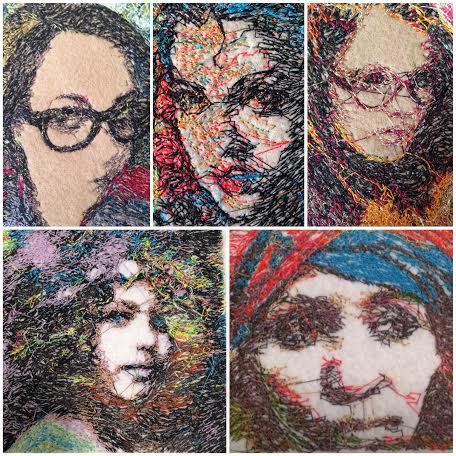
“When I first moved to Philly I had a lot of time on my hands.” MacAllister told me on a summer evening. After finishing with her day job, we met at the office she has at Culture Works, where she conducts business related to her artistic work. If she is not at her day job, or making her art, MacAllister is taking a class or being an active participant in art communities. Putting in all this time for her work is more than typical, “it is a basic need” for her.
“I started going to these social events with poets, but I needed something to do with my hands, so I would even be there sitting knitting at these events, I really liked to sew, my grandmother taught me, I was born on her 60h birthday. I like to be able to spin my own yarn and create materials and I guess that comes from this love I have for things that remind me of my grandmother.”
While her grandmother did not teach MacAllister to spin yarn into thread, they would talk about fiber arts and read books on knitting and sewing together. The wheel she spins fiber into thread on to is the only one of its kind in America, MacAllister tells me. The others are exclusively used in Tanzania. The spinning itself, she learned when she went to Ethiopia six years ago on a Fulbright-Hays award.
“I think a lot about Ethiopia, it’s almost Ethiopian New Year, and I’m still drawing the women I met there, still drawing friends of mine that are there and turning them into embroideries. I went over and got to spend a lot of time with the fiber communities there, and that’s where I learned to hand spin, in Ethiopia. Every time I spin (thread), I think of Ethiopia.”
Many aspects of the fiber communities in Ethiopia she visited appealed to her, but one thing stood out to her. The community itself and the ability for fiber arts, whether spinning, weaving, sewing or knitting, that across cultures these activities were social activities that created bonds.
“The families work together on weaving, it’s cooperative, but I think a lot of fiber work is like that, being able to learn fiber, show other people, and keep the tradition going. For me, I know I have things I didn’t learn from my grandmother, but because now I’m part of the Philadelphia Guild of Handweavers, I’m learning from all of those people over there. Master felting classes, spinning classes. I feel like I found what I really wanted to do with my art.”
“It’s kind of a labor of love, but it takes me a long time, I’m at the machine at least three hours during the base of a piece, after that I hand sew for hours and hours and hours.”
MacAllister also concerns herself with where all of her materials come from. That the materials are sustainable, eco-friendly and accessible to all is of the utmost importance. “I go to every fiber festival I can,” she explains of how she obtains her materials, “I go to farms, sheep and wool festivals, and I make sure I get materials from places where I know my money goes directly to that farm and that family and their animals. I get silk from Darn Good Yarn, a nonprofit that helps women in India and Nepal earn a living wage. There is a place out past Lancaster called the Manning’s, where you can just go to this enormous barn, and just get materials directly from those folks. And I seek out materials when I travel, l was in Taos and I made sure I went to a weaving collective, a store in downtown Taos where I spent a lot of time talking to the people who ran in. I thought it was hilarious, they told me, ‘Oh, Julia Roberts got some of this last week.’”
Prior to the embroidery, MacAllister was focusing on painting and poetry as her artistic mediums. In 2014, MacAllister was involved in The Ragdoll Project, a community based art project that create awareness about human trafficking. Through Philadelphia Women’s Caucus for Art, women made ragdolls from hand; the dolls have since traveled to galleries and events internationally. All proceeds from project continue to go directly to women in America and abroad that are survivors of human trafficking and sexual exploitation.
“After we sold those ragdolls I couldn’t stop sewing, and I really started these embroideries after that. It was really getting in touch with everything that bothered me, everything that bothered me about human trafficking, and the things that are wrong in the world; I really wanted to sew the people that were heroes.”
For MacAllister fiber art is very fulfilling because of how physically interactive it is as an art form. It is also about more than the feeling of making something by hand. “For me,” MacAllister said, “fiber has always been about being with people.”
In Philadelphia, there are a few artist communities that MacAllister is involved in that help nurture her growth as an artist. At NextFab, a manufacturing co-operative located in South Philadelphia, she uses machinery to create the embroideries.
Of the process, MacAllister told me she starts by creating a drawing or sketch of a photograph, which she is then able to scan into the machine. “I work collaboratively with the machine.” She said, “You hand feed every single thread, it’s more like painting and using the arm of the machine to help guide it. I get to do a lot of really straight lines and forms, just like an outline, almost like a line drawing in thread, and then on top of that I build little layers of hand sewn embroideries.” Each portrait, even working collaboratively with the machine, can take days to create.
“It’s kind of a labor of love, but it takes me a long time, I’m at the machine at least three hours during the base of a piece, after that I hand sew for hours and hours and hours.”
As for incorporating social issues into her art, it seems to come naturally to MacAllister. “I’m one of those people who always really cared about communities, even as a young teenager.” She finds it not only therapeutic for herself, but for everyone involved. “I found community groups to get involved with, through art making I found it was very comforting to a lot of people who are survivors of different violence, to come together and sew together, to come together and paint a mural, to come together and knit bomb a neighborhood. That can be extremely constructive for people to channel things into art, for me I always channeled all of my things into art.”
Bonnie MacAllister
CultureWorks Greater Philadelphia
Saturday and Sunday, October 3 & 4
12-6
FREE Fiber demos: including spinning, weaving, felting, ice dyeing, creating community sculptures know as knit bombs
 Aja Beech